Pixels & Pedagogy
  • Pedagogy
  • About Me
  • Courses

Teaching Alice Walker's Everyday Use

6/13/2014

3 Comments


Picture
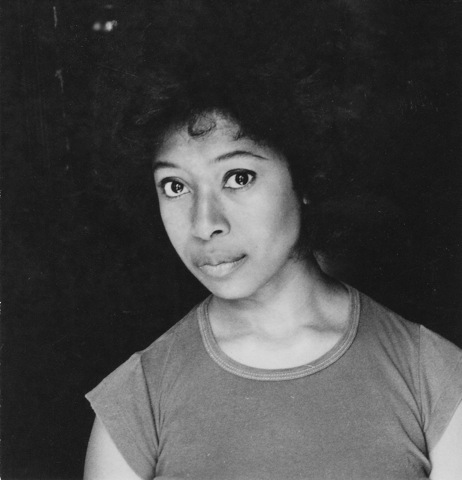
Alice Walker, photo credit: alicewalkersgarden.com, the author's official website
I love teaching this excellent short story by Alice Walker, and I have to say that researching images of quilts to use for this blog post has been a great experience for me. Walker's 1973 short story seems almost prophetic to me now, anticipating the ways that these "use objects" from the past have increasingly become aesthetic objects for preservation, decoration, and contemplation.

Quilting blogs cite Walker's story in praise (which is appropriate since these online communities connect the people who want to preserve this skill rather than the commodity it produces); moreover, quilts are increasingly put in museums as historical object and discussed in artistic communities as aesthetic objects.

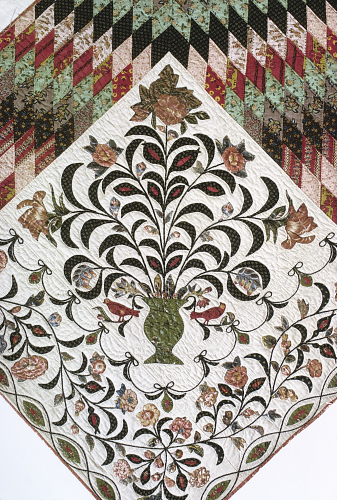
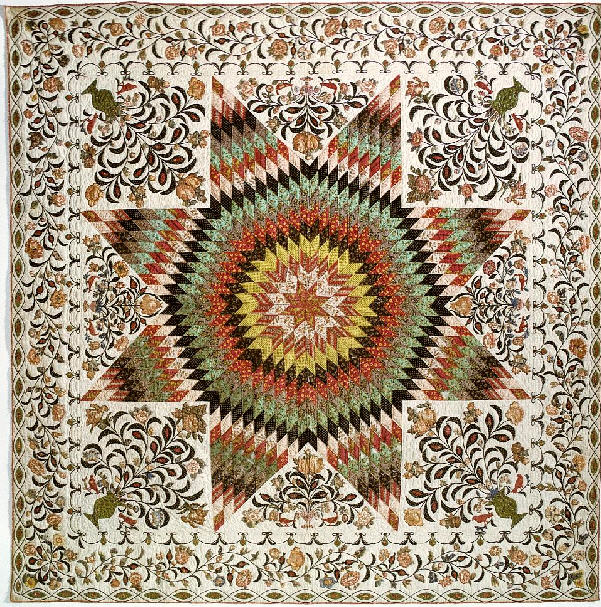
For example, this breath-taking quilt (a variation on the "Lone Star" pattern that Walker mentions specifically in her short story) is housed at the Smithsonian's
National Museum of American History, our nation's premier history museum (click on the image to see the even higher quality images in the museum's online catalog).
Picture
Betsy Totten's "Rising Sun" Quilt, (1825 - 1835).
Picture
Detail of inside border, surrounding the Lone Star
Picture
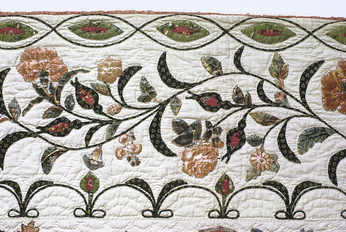
Detail of outside border
Picture
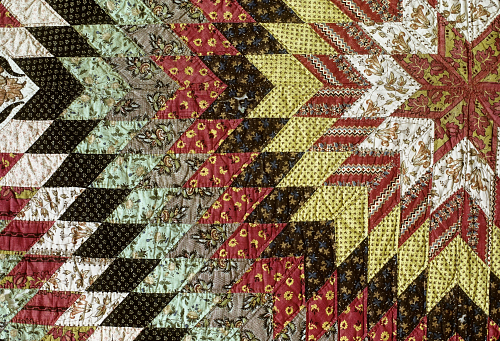
Detail of central "Lone Star" pattern
On the one hand, I think that the urge to preserve quilts is understandable and correct; they really do connect us to the past in a tangible way, as Mama notes in Walker's story: "In both of [the quilts] were scraps of dresses Grandma Dee had worn fifty and more years ago.  Bits and pieces of Grandpa Jarrell’s Paisley shirts.  And one teeny faded blue piece, about the size of a penny matchbox, that was from Great Grandpa Ezra’s uniform that he wore in the Civil War."  Dee/Wangero's sense that these quilts are worth saving because the specific pieces of cloth used in them give her a tangible connection to the past is not a wholly incorrect way to negotiate her relationship to her ancestors.
In contemporary writing, the quilt stands for a vanished past experience to which we have a troubled and ambivalent relationship.

--Elaine Showalter, "
Piecing and Writing," 228
On the other hand, however, putting quilts in museums runs directly counter to the decision that Mama makes in the short story when she chooses to give her quilt to Maggie (who will use the quilt) instead of Dee/Wangero (who will hang it on the wall).  In this story, Walker suggests that one's relationship with the past is better negotiated through lived experience than through fetishized objects.

In the following blog post, I will both present my past strategies for teaching "Everyday Use" and also offer some new suggestions, incorporating research of various kinds.

Close Reading Questions:

Mama's Perception of herself:
  • Is Mama always a reliable narrator?  How does she go back and forth from seeing herself through her own eyes and seeing herself through Dee’s eyes?
  • Compare and contrast Maggie and Dee, and then consider how Mama positions herself between her two daughters over the course of the story.

Mama's Perception of Maggie:
  • Mama says, “Maggie will be nervous until after her sister goes: she will stand hopelessly in corners homely and ashamed of the burn scars down her arms and legs, eyeing her sister with a mixture of envy and awe."  Is this what Maggie actually does?
  • Mama says, “I hear Maggie suck in her breath. ‘Uhnnnh,’ is what it sounds like. Like when you see the wriggling end of a snake just in front of your foot on the road. ‘Uhnnnh.'"  How does Mama seem to interpret Maggie’s grunt?  What are other ways to interpret this sound?
  •  Why does Mama want to see Maggie as afraid of Dee?

Tense shifts:
“No, Mama," she says. “Not 'Dee,’ Wangero Leewanika Kemanjo!”

“What happened to 'Dee’?” I wanted to know.

"She's dead," Wangero said. "I couldn't bear it any longer being named after the people who oppress me.”
  • Notice the verbs in this passage.  What happens?  What impact does that shift have?  What does Walker (or Mama) gain by that shift? Does, perhaps, present-tense narration seem to be a more passive indication of the narrator's immediate observations, whereas past-tense narration offers more of a sense that the narrator is actively shaping the events that she wants to tell into a story? Does it create a distance between Mama and Dee/Wangero?

Speech in "Everyday Use"
:
“She used to read to us without pity; forcing words, lies, other folks' habits, whole lives upon us two, sitting trapped and ignorant underneath her voice. She washed us in a river of make-believe, burned us with a lot of knowledge we didn't necessarily need to know. Pressed us to her with the serious way she read, to shove us away at just the moment, like dimwits, we seemed about to understand.”

"Impressed with her they worshiped the well-turned phrase, the cute shape, the scalding humor that erupted like bubbles in lye. She read to them.”

“I did something I never had done before: hugged Maggie to me, then dragged her on into the room, snatched the quilts out of Miss Wangero's hands and dumped them into Maggie's lap. Maggie just sat there on my bed with her mouth open.”

“And then the two of us sat there just enjoying, until it was time to go in the house and go to bed.”
Compare and contrast these depictions of speech, action, and silence.  Who talks, and to what effect?  How do Mama and Maggie find their voices when speech is poisoned through Dee’s influence?

New Directions:

I will attempt to present alternatives for targeting student research projects toward a variety of grade levels.

Literary and historical research:


For older students: David Cowart's essay "Heritage and Deracination in Walker's "Everyday Use" (first published in Studies in Short Fiction 33 [1996]: 171-84, and then reprinted in
Critical Essays on Alice Walker, ed. Ikena Dieke [Westport, Conn.: Greenwood Press, 1999], 23-32) would be an excellent essay for the presentation assignment.

For younger students: Cowart's basic thesis--that Walker is critiquing certain elements of the rhetoric of 1960s black consciousness (specifically how superficial people are co-opting the radical aims of the movement to fashion a flashy but phony to "African" identity, which in turn undermines the movement's real and worthwhile goal to empower African-Americans)--is a thesis that can be explained by putting certain images or allusions of the short story into context.   David White's essay
"'Everyday Use': Defining African-American Heritage" makes a very similar argument in much simpler language for younger or less advanced students.
Picture
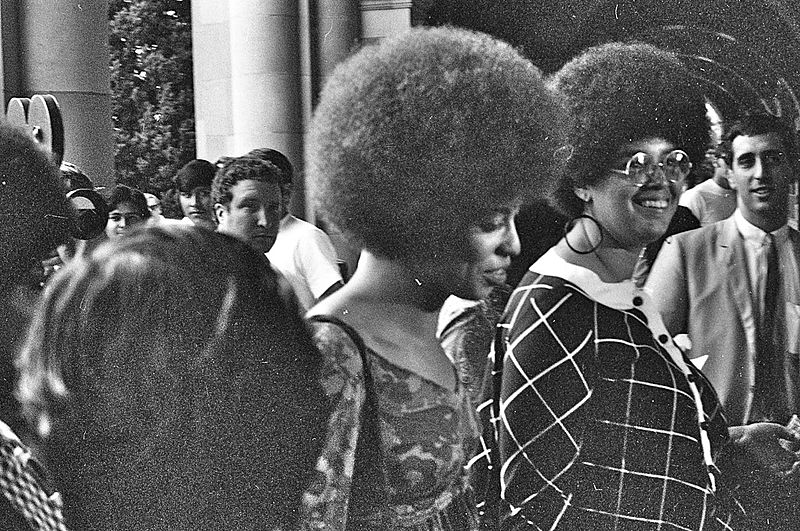
Angela Davis enters Royce Hall for first lecture October 7 1969, photo by George Louis

Either of the essays above could be a springboard into research into the civil rights movement, specifically, the Long, Hot Summer of 1967, the rise of an Islamic alternative to Christianity for African-Americans, Black nationalism and Afrocentrism, and even W.E.B. Dubois' defection to Africa in 1961.  Dee fancies herself to be Angela Davis, but she alienates her family and isolates herself from the "heritage" that she claims to know and love so much.

In either case, students would read the literary essay and then research some of the historical figures and events mentioned in relationship to the civil rights movement. How does Walker present Dee/Wangero as superficial version of black consciousness and to what effect? How does that help to explain Mama's choice?

Imagining an alternate ending:
Picture
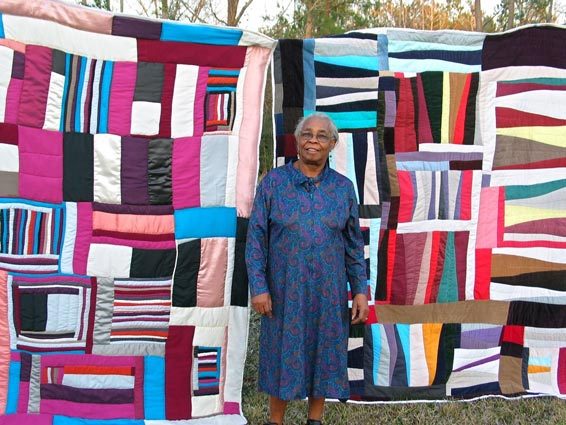
Mary Lee Bendolph, one of the famous quilters from Gee's Bend, AL, stands with a collection of the Gee's Bend Quilts. Photo by Matt Arnett, © 2009 The Seattle Times Company
The second research route into the short story would be through the long(-ish) lens of history since the short story was written. As I mentioned in the lede to this post, African American quilts have become sought-after objets d'art that sell for upwards of $20,000 and hang in museums all over the country.

When the beautiful quilts made by the women of Gee's Bend, Alabama arrived at the Whitney Museum in New York, they were greeted with ecstatic praise by the art community.  Michael Kimmelman of the New York Times wrote:
[The quilts] turn out to be some of the most miraculous works of modern art America has produced. Imagine Matisse and Klee (if you think I'm wildly exaggerating, see the show) arising not from rarefied Europe, but from the caramel soil of the rural South in the form of women, descendants of slaves when Gee's Bend was a plantation.
Another exhibition of the quilts, this time at the Museum of Fine Arts, Houston, was also highly praised in the Smithsonian.  Neal Conan dedicated an edition of NPR's Talk of the Nation to showcasing the Whitney exhibit and the quilters, a broadcast that I have also embedded below. A playwright-in-residence of the Alabama Shakespeare Festival, Elyzabeth Gregory Wilder, even wrote a play--Gee's Bend--about the quilters, a play that has been performed at venues all around the country.
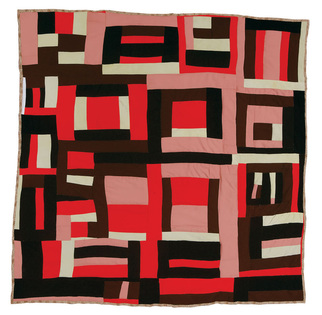
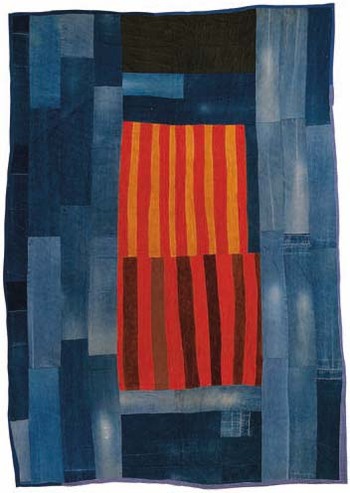
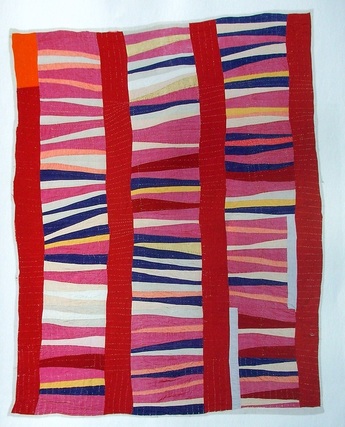
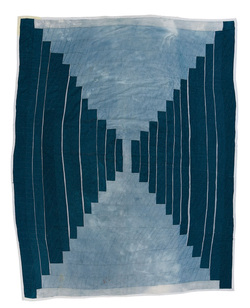
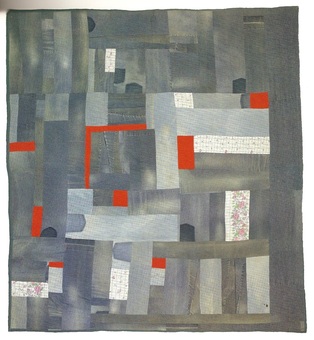
Now, all this effusive praise is indeed merited. The quilts really are shockingly beautiful:
Picture
Annie Mae Young, "Work-clothes quilt with center medallion of strips," 1976
Picture
Jessie T. Pettway's "Bars and String-Piece Columns," c. 1950
Picture
Mary Lee Bendolph, "Housetop" variation, 1998
Picture
Loretta Pettway, "Bricklayer" variation c. 1970
Picture
Mary Lee Bendolph's "Work-Clothes Quilt," 2002
University of Auburn has a webpage where you can view additional quilts, and Elizabeth Leach Gallery in Portland, Oregan has a collection of quilts for sale.

The fact that there is a price tag attached to the quilts drives home the idea that's implicit in Walker's short story: hanging the quilts on the hall instead of using them turns the quilts into a commodity instead of preserving the practice of making them.

One of the conversations, however, that emerges from this discussion is that younger generations (in Gee's Bend in particular) are newly motivated to learn the practice, and that the exposure that the women are getting now might contribute to a revival of the quilt-making tradition.

Another benefit of turning the quilts into aesthetic objects is to turn people's attention to these women as artists who matter. For example, the State of Alabama commissioned a series of interviews with the quilters to promote the "Year of Alabama Arts." I posted only one of the interviews below, but you can watch the whole playlist here.
The sense of pride that these women take in the fact that their work is respected and admired is both heartwarming and poignant.

An alternate research assignment would be to have students learn about the Gee's Bend quilters through the various links I've provided above and through their own independent research. Then ask students to write about how their research has affected their reading of Walker's short story either through expository writing or through a creative assignment such as revising the ending to the story or telling the story through Wangero's point of view. For ideas about incorporating creative writing into the classroom, see Erin Breaux's post Creative Writing in the Literature Classroom.
Next page
Last page
3 Comments

Teaching Elizabeth Bishop's Poetry in Context

5/27/2014

1 Comment


Picture
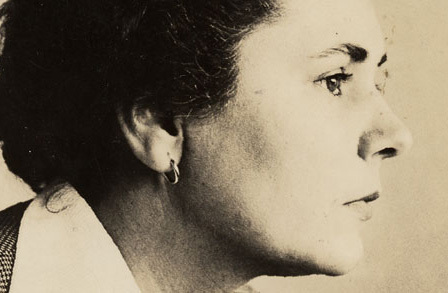
Elizabeth Bishop, © Joseph Breitenbach
This spring, I inherited a syllabus that had been hodge-podged together from several of my colleagues at the OHS over the years, and while some of the texts didn't work together anymore after so many years of Frankenstein-ing the syllabus, one really productive grouping was Virginia Woolf's Mrs. Dalloway, photographs by Henri Cartier-Bresson, and several poems by Elizabeth Bishop: "In the Waiting Room," "The Filling Station," and "The Moose."

The thread that tied these texts together was James Joyce's modernist notion of the epiphany, an aesthetic philosophy that he develops in Stephen Hero.
The three things requisite for beauty are, integrity, a wholeness, symmetry and radiance.

--James Joyce, Stephen Hero (1944)
Joyce outlines a three-step process of an "epiphany," a secularized moment of inspiration that borrows the language of religious revelation.
  1. The object is understood as a discrete entity that stands apart from the rest of the universe. Its integrity or wholeness becomes an object of meditation.
  2. The object is understood as being perfect in its own kind. Its symmetry and beauty are considered.
  3. The object's "soul" leaps out to the observer. It offers the viewer an epiphany in its radiance.
Now this discussion of objects and their "souls" works really well in two ways: 1) it creates a cohesion for all the modernists texts I've indicated above, and 2) it works really well as a point of contrast  later in the semester for developing a working definition for postmodernism, which is a concept that is legitimately hard to define. (I have discuss this before in my post on Pynchon).

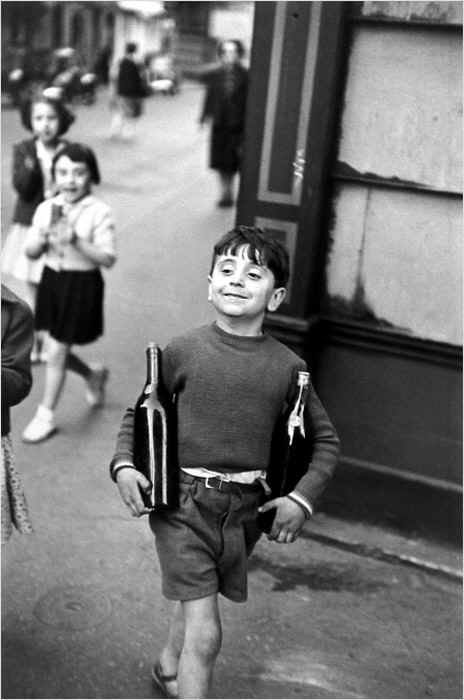
It's also useful to contrast the model of "epiphany" to what Carter-Bresson calls the "decisive moment" in photography:
To me, photography is the simultaneous recognition, in a fraction of a second, of the significance of an event as well as of a precise organization of forms which give that event its proper expression.

Henri Cartier-Bresson, The Decisive Moment (1952)
Although Cartier-Bresson and Joyce differ in the way that they are talking about the gaze (is it mediated through the artist, or is it experienced directly by the reader/viewer?) they align in their conception that suspended moments of time communicate real meaning or significance.
Picture
Henri Carter-Bresson, Rue Mouffetard (1958)
Cartier-Bresson is considered the "father of street photography" and he is a major influence in both photojournalism and photography as an art form. You can browse through a wide array of his photographs at the Magnum Photography website.

We can see this idea of the revelatory instant--whether its an epiphany or a decisive moment--at work in Woolf's novel in many ways: Clarissa shopping at Bond Street, Septimus waking up from his hallucinations to find Rezia making a hat, Peter looking at Clarissa and feeling excited and comforted that Clarissa simply exists just so, etc.
She had the oddest sense of being herself invisible; unseen; unknown; there being no more marrying, no more having of children now, but only this astonishing and rather solemn progress with the rest of them, up Bond Street, this being Mrs. Dalloway; not even Clarissa any more; this being Mrs. Richard Dalloway.

Bond Street fascinated her; Bond Street early in the morning in the season; its flags flying; its shops; no splash; no glitter; one roll of tweed in the shop where her father had bought his suits for fifty years; a few pearls; salmon on an iceblock.

--Virginia Woolf, Mrs. Dalloway


In the passage above, Clarissa takes comfort in the material objects around her. They ground her and make her feel suddenly less invisible. They pique her interest and then make her feel that both she and they are real and have meaning. I like to have my students compare and contrast some of the major moments of epiphany in the book.

The epiphany is apparent also in Bishop's three poems.
Picture
Martin and Osa Johnson, c. 1940
Picture
Mursi tribe Woman Reading Vogue Magazine - Omo Valley Ethiopia, © Eric Lafforgue
In the first of the poems, "In the Waiting Room," a child narrator comes to a sudden realization about identity through meditating on a National Geographic magazine while she waits for her aunt in the eponymous waiting room. This poem raises many questions about individual and group identity. It also establishes a complicated temporal shift: the writer reflects back on a moment in her childhood, but the speaker (a child) looks forward in terror to what it will mean to grow up and lose her individual identity through affiliation with other groups: age, familial, gender, cultural, etc.

In the second poem, "The Filling Station," a narrator meditates on the material objects of a family-run gas station shifting her perspective so that she stops thinking of the place as a "dirty" place of business and begins thinking of it as a home where people live and love.  There is a wonderful recording of Bishop reading her poem at this website. In her recitation, Bishop calls attention to a central question in her poem: does the narrator show a lazy sense of complacency, or is this a profound moment of empathy and connection across class boundaries?

In the third poem, "The Moose," a narrator moves from a hazy-dreamlike state into a sudden shock of reality when her bus trip through New Brunswick is interrupted by a moose crossing out of the fog into the street. This one is harder than the others because the moose itself is a complicated symbol in the poem: she is ugly and smells bad, but she somehow makes all the passengers on the bus feel a sudden sensation of joy.
Picture
A photograph of a female Moose in Denali National Park and Preserve © Derek Ramsey 2006
In each case, I ask my students to consider how the poem both depicts an epiphany, according to Joyce's definition, and offers the reader his or her own epiphany.  In more advanced classes, I might ask my students to then consider the frame of mediation that Cartier-Bresson proposes in his definition of the "decisive moment."

The decisive moment differs from the epiphany in that the important gaze comes from the perspective of the photographer and not from our perspective as viewers. In other words, the image is “decisive” because Cartier-Bresson has decided to mediate it or frame it just so for his viewers. As such, it tells us just as much about Cartier-Bresson’s artistic subjectivity as it tells us about the “real” world. The image may cause us to have an epiphany, but it also expresses something about the world that Cartier-Bresson wants us to see. We could investigate Bishop's poems (or, indeed, Woolf's novel) from this perspective as well.

The following are my paper prompts for their paper related to these texts:
  1. Compare and contrast the “decisive moment” in one of Cartier-Bresson’s photographs to the moment of falling in Bishop’s poem “In the Waiting Room.” Think about how formal elements of the image and the poem structure a moment in time. What kind of philosophy of subjectivity emerges from Bishop’s poem, and does Cartier-Bresson suggest a similar philosophy in his photograph? How do you know and why does it matter?
  2. Compare and contrast Mrs. Dalloway’s contemplation of Septimus’ suicide with the speaker’s contemplation of the family who lives about the gas station in “The Filling Station.” How does meditating on another person’s suffering help these characters to think about their own sense of self? What kind of philosophy of subjectivity does that suggest?
  3. Compare and contrast the moose in Bishop’s “The Moose” to something that Oedipa finds during her quest in The Crying of Lot 49. Do these textual moments subvert the “modernist sublimity” that we talked about in relation to the concept of the epiphany? Why or why not?
  4. Consider one of the suspended instants in Mrs. Dalloway that we’ve talked about in relation to the “thusness” of a thing and compare it to a comparable moment in The Crying of Lot 49. For example, Oedipa ponders several kinds of objects such as stamps, obscure textual variants of the fictional Jacobean tragedy The Courier’s Tragedy, and pseudoscientific objects related to entropy and demons, etc. What different kinds of philosophies about subjectivity emerge in the modern and the post-modern texts as a result of a character’s meditation on these material objects?

Last page
Next page
1 Comment
Forward>>

    Claire Dawkins

    English Instructor at Stanford's Online High School

    Archives

    August 2015
    May 2015
    October 2014
    September 2014
    June 2014
    May 2014
    April 2014

    Categories

    All
    Assignments
    Beaumont
    Behn
    Beowulf
    Bishop
    Brathwaite
    Cartier-Bresson
    Chaucer
    Coleridge
    Creative Writing
    Dickinson
    Donne
    Early American Literature
    Exams
    Gender Theory
    Genre
    Glaspell
    Horace
    John Smith
    Lesson Plans
    Literature Of Exploration
    Melville
    Milton
    My Smart Friends
    Ovid
    Pearl Poet
    Pynchon
    Queen Elizabeth I
    Rowlandson
    Shakespeare
    Sophocles
    Spenser
    Sterne
    Texts And Contexts
    Theory
    Visual Analysis
    Walker
    Whitman
    Williams
    Woolf
    Writing Instruction

    RSS Feed

Proudly powered by Weebly