Pixels & Pedagogy
  • Pedagogy
  • About Me
  • Courses

Act 3 of Twelfth Night and the Haven of Pleasure

5/14/2015

1 Comment


Picture
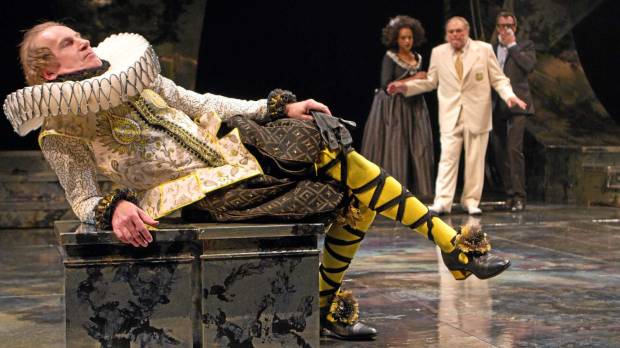
Tom Rooney as Malvolio in the Ontario Stratford Shakespeare Festival's 2011 production of Twelfth Night, directed by Des McAnuff
Act 3 of Twelfth Night features another cross dresser: Malvolio, who is dressing across class instead of across gender like Viola. I find the image above to be so, so delightful.

I like to pair this act with the very brief passage that Bruce Smith excerpts from The Haven of Pleasure, Containing a Free Man's Felicity and a True Direction How to Live Well (1596) in his Texts and Contexts edition of Twelfth Night. Here are some of the pertinent passages:
But seeing that women desire to be decked and trimmed above all other creatures, who apparel themselves gorgeously to the end they may seem fair and beautiful to men, the apostle Peter warneth matrons that they bestow not too much cost on their world of furniture [clothing], not prostitute or set themselves to sale to such as may be them… but with modest attire, sober and not over-curious apparel, to please their husbands, by seeking to get their favors and good will.

But there are many in ours and our forefather’s time who appareling themselves with gorgeous apparel… have brought themselves to beggary and extreme poverty, who are then flouted of [insulted by those] such as helped them to spend their patrimonies, and of them also who by deceit, craft, cunning, and fraud have so scraped their wealth from them that they have not so much as a farthing to bestow on the relief of the poor that are brought to extreme penury and want.

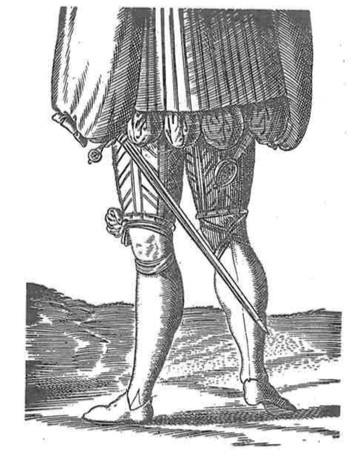
As a “sort of Puritan” Malvolio ought to dress in “modest attire, sober and not over-curious.” What are the other taboos that he breaks by donning his “strange, stout” (2.5.136) leg fashion? Does he effeminize himself? Does he reveal his social aspiration? Does that make him different from the other characters or is he the flip-side of the same coin?
Fabian. O, peace! now he's deeply in: look how
imagination blows him.


Malvolio. Having been three months married to her, sitting in
my state,— Calling my officers about me, in my branched velvet
gown; having come from a day-bed, where I have left Olivia sleeping,— And then to have the
humor of state; and after a demure travel of regard, telling them I know my place as I would they should do theirs, to for my kinsman Toby,— Seven of my people, with an obedient start, make out for him: I frown the while; and perchance wind up watch, or play with my—some rich jewel. Toby approaches; courtesies there to me, I extend my hand to him thus, quenching my familiar smile with an austere regard of control,—Saying, 'Cousin Toby, my fortunes having cast me on your niece give me this prerogative of speech,'— 'You must amend your drunkenness.’
How do questions of sexual power, gender identity, and class identify get tied up with clothing in Malvolio’s fantasy? What does it matter that he has the fantasy before finding the letter? If Malvolio shares traits with certain members of the festive court (i.e., Andrew attempts to marry up, Maria does marry up, and Malvolio secretly fantasizes about marrying up) then why are they so quick to pull their prank on him?

How does Maria capitalize on her knowledge of Malvolio in the letter trick? Why does clothing play a part in her scheme? How is clothing a weapon?
Picture
Picture
Act 3 Scene 4 (when Malvolio comes out in his yellow stockings) is almost always enormously successful in the theater.  What makes it so funny?  

It seems almost irresistible that the audience would be on the side of the conspirators against Malvolio.  Does that lend weight to reading him as someone necessarily in opposition to the festive group (and maybe even playgoers)?

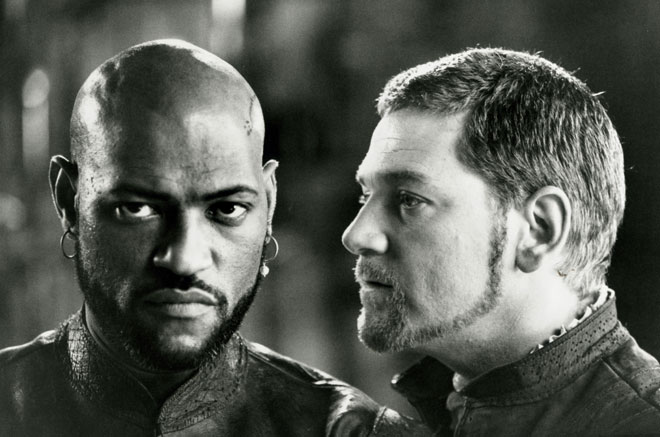
This discussion ties in with the scene between Olivia and Viola/Cesario that echoes both a passage from Exodus and a passage from another of Shakespeare's plays, Othello:
Moses said to God, “Suppose I go to the Israelites and say to them, ‘The God of your fathers has sent me to you,’ and they ask me, ‘What is his name?’ Then what shall I tell them?”

God said to Moses, “I am who I am. This is what you are to say to the Israelites: ‘I am has sent me to you.’”
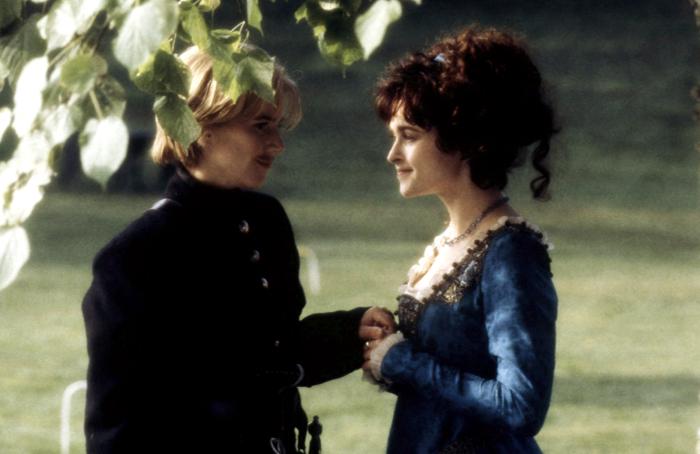
OLIVIA. Stay: I prithee, tell me what thou thinkest of me.
VIOLA. That you do think you are not what you are.
OLIVIA. If I think so, I think the same of you.
VIOLA Then think you right: I am not what I am.
In following him, I follow but myself;
Heaven is my judge, not I for love and duty,
But seeming so, for my peculiar end:
For when my outward action doth demonstrate
The native act and figure of my heart
In compliment extern, 'tis not long after
But I will wear my heart upon my sleeve
For
daws to peck at: I am not what I am.
It's worth it to ask students to think about what it means that Viola and Iago use the exact same language, and that their language specifically perverts God's name in Exodus. In the case of Othello it seems clear that we are meant to see the deep chasm between seeming and being as a sign of Iago's fundamentally evil nature. It's not so clear that we are meant to see that same schism between seeming and being as a sign of wickedness in Viola. Are we meant to see the schism between Malvolio's reality and his fantasy as wicked? Or is he, like Viola, not really as blameworthy as Iago? For the characters of Twelfth Night the slippage between seeming and being is tied to their clothing, whereas for Iago this duplicity manifests in his actions and his face.  What is the significance of that? Are clothes always tied to a discussion of seeming and being?
Next Page
Last Page
1 Comment

Acts 1 & 2 of Twelfth Night with Hic Mulier

5/13/2015

0 Comments


Picture
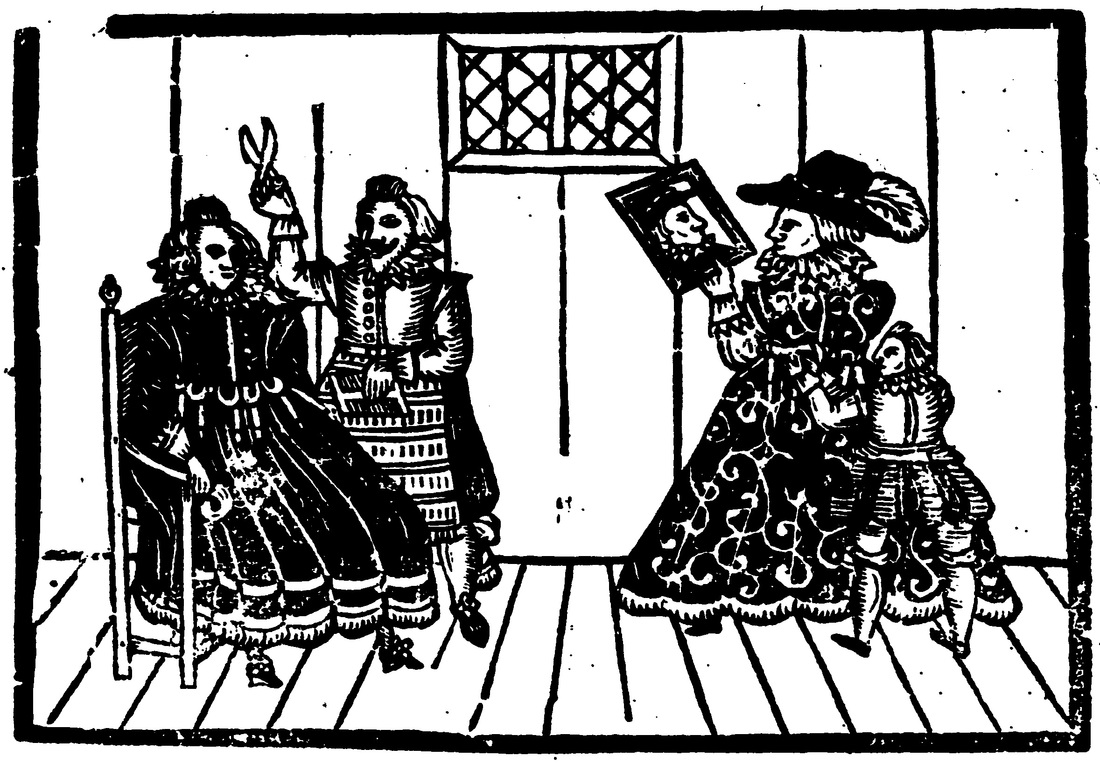
Detail from the title page of the anonymously published Hic Mulier: Or, The Man-Woman (1620)
Hic Mulier is an anonymously published pamphlet that derides the apparent trend in London in the early seventeenth century for women to adopt certain flourishes of masculine attire in their dress (the "lascivious" feather in the hat is apparently super phallic). The title is a pun in Latin that translates to "this mannish woman." The pamphlet is in the genre of the querelle des femmes, a literature that debates the "woman question"--whether or not women have worth, are as virtuous as men, etc. The genre was enormously popular in the fifteenth, sixteenth, and seventeenth centuries as the printing press made it much cheaper to make texts than ever before.

So, first of all, I do not think that it is entirely necessary to teach the entirety of Hic Mulier in order to make it productive for high school students. The excerpt in the Norton Critical Edition of The Roaring Girl is just about perfect in length, and it's a great excerpt. Here are some great passages that I like to begin with:
It [the vogue for adopting masculine apparel] is an infection that emulates plague and throws itself amongst women of all degrees, all deserts, and all ages; from the capitol to the Cottage are some spots or swellings of this disease. Yet evermore the greater the person is, the greater is the rage of this sickness; and the more they have to support the eminence of their fortunes, the more they bestow in the augmentation of their deformities…

They swim in the excess of these vanities and will be manlike not only from the head to the waist, but to the very foot and in every condition: man in body by attire, man in behavior by rude complement, man in nature by aptness to anger, man in action by pursuing revenge, man in wearing weapons, man in using weapons, and, in brief, so much man in all things that they are neither men nor women, but just good for nothing.
This is a great way into Twelfth Night, because you can ask student to compare the motivations for cross dressing that this anonymous author imagines for women with the motivations that Shakespeare gives to Viola. Why does she decide to dress like Cesario initially? Is she consistent with her choices about how she will cross dress?

This actually is a great opportunity to close read Viola's first scene. Here's the pertinent passage:
Viola. O my poor brother! and so perchance may he be [saved].

[Captain says that he thinks he saw Sebastian escape drowning]

Viola. For saying so, there's gold:
Mine own escape
unfoldeth to my hope,
Whereto thy speech serves for authority,
The like of him.
Know'st thou this country?

Viola. Who governs here?

Viola. What is the name?

Viola. Orsino! I have heard my father name him:
He was a bachelor then.


Viola. What's she?

Viola. O that I served that lady
And might not be delivered to the world,
Till I had made mine own occasion mellow,
What my estate is!

There are a couple of things of note in this passage. First of all, it is a bit weird that Viola gives money to the ship captain for admitting that her brother might not be drowned: "For saying so, there's gold." I ask my students to consider what it would mean to give someone money for saying something that you want to hear. How does that establish a power dynamic?

Additionally I ask them to think about the course of the conversation and whether it seems "natural," or if we could imagine that Viola is leading the Captain with certain statements to give her the kind of information that she wants (and/or is paying him for).

Generally speaking, students have two kinds of readings of Viola. They tend to see her as either an optimistic, happy-go-lucky kind of girl who is pretty passive, or they see her as a powerplayer who first turns this Captain into her informant, then sets her eyes on Orsino before even meeting him, and finally takes Olivia out as her potential rival.  I've taught this play many times, and it's amusing to me how ardently some students become invested in the idea of Viola as a passive but plucky heroine who stumbles into a situation that she cannot fix and waits for time to "untangle" this knot for her. 
Picture
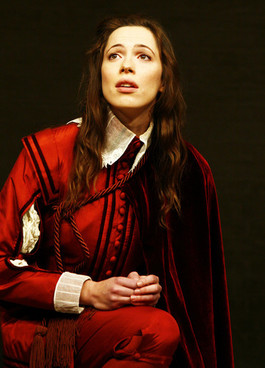
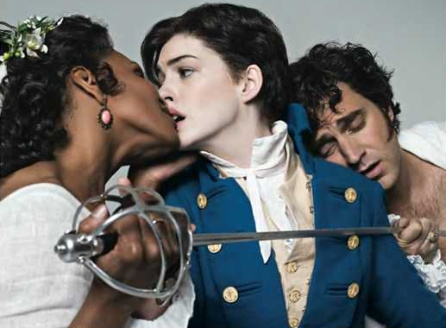
Rebecca Hall as Cesario in the National Theatre's 2011 production of Twelfth Night, directed by Peter Hall.
Picture
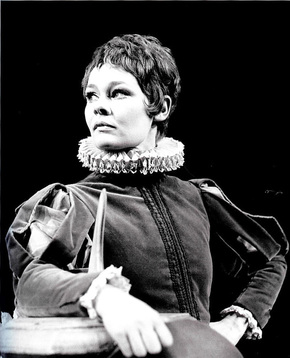
Dame Judi Dench as Cesario in Twelfth Night for The Royal Shakespeare Company in 1969.
It's kind of fun to ask students why they would think less of a calculating, assertive, resourceful survivor instead of a sweet, innocent, passive girl. How might their own assumptions about what it means to be a "good woman" being influencing their desire to read Viola a particular way?

Whether we read her as winking at the audience when she later exclaims, "Fortune forbid my outside have not charmed her!" about Olivia's sudden and overwhelming attraction to Cesario, or we see her as genuinely distressed at the "wickedness" of her disguise, we can see that Shakespeare does not assume the same motivations for female cross dressing as the author of Hic Mulier.  Viola's decision to cross dress reads as either necessary (to protect herself from bodily harm) or as calculating (to gain access to Orsino), but it is not portrayed as toxic and evil.  Even when she later calls herself a monster, she calls herself a "poor monster," which suggests a sympathy entirely lacking from the description of the monstrous "good for nothing" man-woman in Hic Mulier.

This leads to a nice discussion about gender roles for men as well.
If music be the food of love, play on;
Give me excess of it, that, surfeiting,
The appetite may sicken, and so die.
That strain again! it had a dying fall:
O, it came o'er my ear like the sweet sound,
That breathes upon a bank of violets,
Stealing and giving odour!
It would perhaps be most logical to start with 1.2, where we see the aftermath of the shipwreck. It is, after all, Viola's decision to cross dress that sets the plot into motion. So, why begin with Orsino's demand for more music, more love? This passage is well worth close-reading in class, and it sets the stage nicely for Haec Vir, which we read in conjunction with Acts 4-5.
Next Page
Last Page
0 Comments

Gender and Clothing in Shakespeare's Plays

5/13/2015

1 Comment


Picture
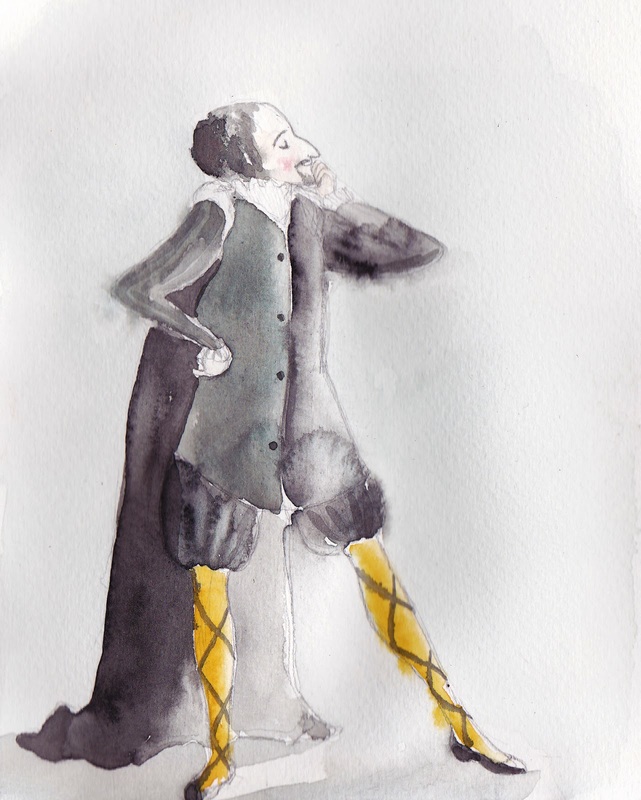
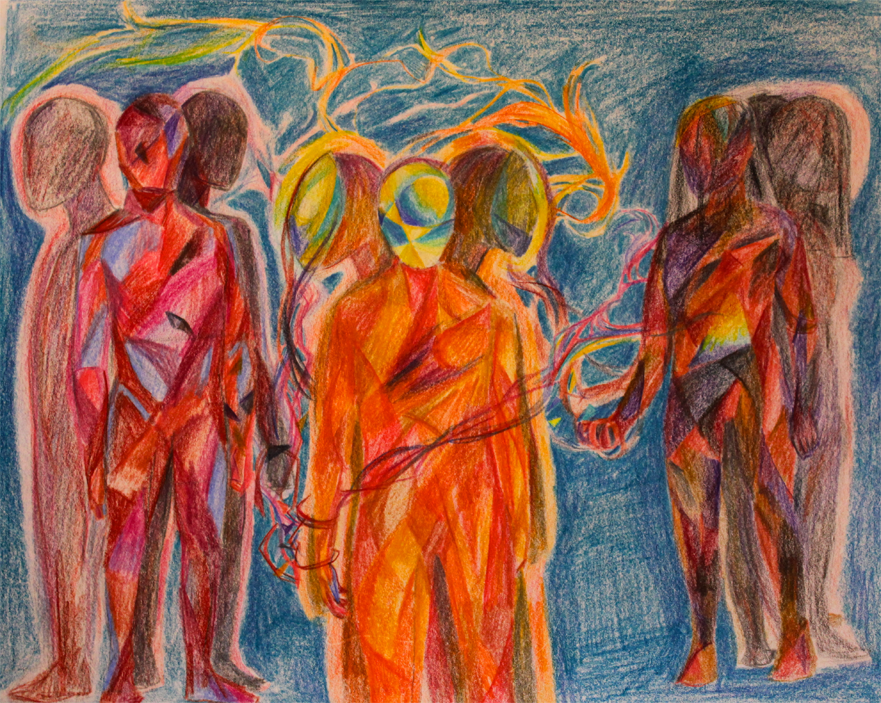
This beautiful image was drawn by one of my talented students this year. Click the image to read about her thought process as she was designing the image.
I have just finished teaching one of the most satisfying courses of my career: a course called "Gender and Clothing in Shakespeare's Plays." I might have also titled the course "Shakespeare's Cross-Dressed Heroines," but I didn't really want to run the risk of offending any conservative parents at our high school. My course name allowed me to fly under the radar as it were.

There were a couple of major goals I had for the course, and I think that they came together really nicely.
  1. I wanted to develop a vocabulary for these students to talk about gender identity, biological sex, gender performance, and sexuality.
  2. I wanted to interrogate and trouble their assumptions about what those categories might have meant for Shakespeare within his contemporary setting.
  3. I wanted them to think about how form (such as genre) might offer Shakespeare ways to produce competing theories of gender, sex, performance, and sexuality.
  4. I wanted to interrogate and trouble their assumptions about what those categories mean for us as we use Shakespeare in our own culture.
In the next few blog posts, I am going to move through some of my materials and my strategies for accomplishing these goals.

I did introduce these students to literary theory and criticism, so this course might not be appropriate for all high school students. This is a sort of cross-over class between high school and college-level. The theorists we focused on the most in order to establish our vocabulary were David Halperin (How to Do the History of Male Homosexuality) and Judith Butler (Gender Trouble). I wove short passages of both of these in organically into the classroom instead of establishing the vocabulary right away. I think that this was best because we sort of led up to Butler. By the time we got there, they were ready to hear the revolutionary idea (for them) that their inwardly felt, "natural" sense of gender identity might be an internalized construct that comes from social norms.
Picture
In the place of an original identification which serves as a determining cause, gender identity might be reconceived as a personal/cultural history of received meanings subject to a set of imitative practices which refer laterally to other imitations and which, jointly, construct the illusion of a primary and interior gendered self or parody the mechanism of that construction.
In order to address my second aim for the course, I included contexts for Shakespeare's plays throughout the syllabus. This is not a new thing for me, but I felt like this was the first time I have met with any success in designing a texts and contexts course. The secret for me this semester has been in the working ahead of time to select short, pertinent contextual material that comments directly on the play at hand. I worked to show my students that Shakespeare was not writing in a vacuum; rather, he was working from within a culture that hotly contested gender roles, biological sex, feminine authority, theatrical practices of cross-dressing, and the intersection of gender identity and sexuality.  The contextual materials are generally harder for the students to digest than the plays, so they really needed to have short passages and passages that spoke directly to the themes of individual acts and scenes.

Broadly speaking, I grouped my course into six units:
  1. Twelfth Night and the querelle des femmes pamphlet wars
  2. As You Like It and Puritan polemics against theater and clothes
  3. Antony and Cleopatra and the "tragedy" of female authority
  4. The sonnets in the contexts of desire
  5. Cymbeline and advice manuals to women
  6. Portia and Mary Frith: cross-dressed women and the law

As you can see, I was working across a generically diverse range of plays so that I could get at that third goal in my course: consider how form affects the discourse about gender for Shakespeare. We began with the comedies, proceeded to a tragedy, and then sonnets. We ended the course with more nebulous genres such as romance and then a play that is often categorized as a problem play. 
Finally, I asked students to investigate our current articulations of gender through the use of Shakespeare in our culture. One of the ways that I did this is through a performance critique paper and the other way was through a creative project, wherein students had to adapt one of the plays that they read into a new medium (the lede image to this blog post is the result of one such project!).

I will talk about these projects at greater length in upcoming posts, but I want to say briefly here that I really liked this twin approach to the course. Starting from our contemporary moment and looking back (on one hand) and starting from the historical debates contemporary to Shakespeare and then looking forward (on the other hand) really helped to destabilize narratives that the students had constructed about both the "progress" of history and the absolute difference between Shakespeare's day and our own.
Next Page
Last Page
1 Comment
Forward>>

    Claire Dawkins

    English Instructor at Stanford's Online High School

    Archives

    August 2015
    May 2015
    October 2014
    September 2014
    June 2014
    May 2014
    April 2014

    Categories

    All
    Assignments
    Beaumont
    Behn
    Beowulf
    Bishop
    Brathwaite
    Cartier-Bresson
    Chaucer
    Coleridge
    Creative Writing
    Dickinson
    Donne
    Early American Literature
    Exams
    Gender Theory
    Genre
    Glaspell
    Horace
    John Smith
    Lesson Plans
    Literature Of Exploration
    Melville
    Milton
    My Smart Friends
    Ovid
    Pearl Poet
    Pynchon
    Queen Elizabeth I
    Rowlandson
    Shakespeare
    Sophocles
    Spenser
    Sterne
    Texts And Contexts
    Theory
    Visual Analysis
    Walker
    Whitman
    Williams
    Woolf
    Writing Instruction

    RSS Feed

Proudly powered by Weebly