Pixels & Pedagogy
  • Pedagogy
  • About Me
  • Courses

Teaching Stevenson's Jekyll and Hyde

6/4/2014

1 Comment


Picture
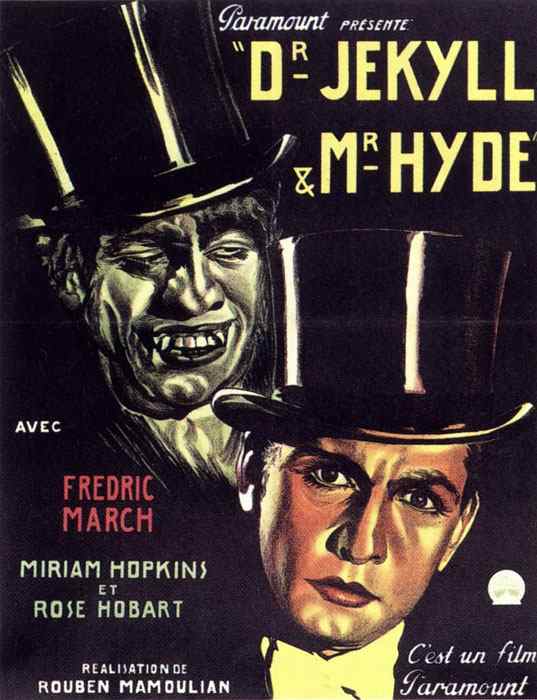
Movie poster for Mamoulian's Dr. Jekyll and Mr. Hyde (1931) © Paramount Pictures
Like many teachers this time of year, I am both wrapping up the end of my current courses and starting to think distantly about upcoming courses.

I'm in the process of overhauling one semester of my AP Lit class to include a text that I have taught many times before, which I absolutely love for both pleasure reading and for teaching: Robert Louis Stevenson's Strange Case of Dr. Jekyll and Mr. Hyde. If you haven't read it before, add it to your list for summer reading! I thought I would blog about it since it's been in the back of my mind for weeks now.

As far as teaching goes, I find that it is super useful to have students consider the following letter that Stevenson wrote in response to a clergyman's complaint that the book's moral was too obscured:

I conceive I could not make my allegory better, nay, that I could not fail to weaken it, if I tried. I have said my say as I was best able: others must look for what was meant; the allegorist is one, the commentator is another; I conceive they are two parts.
Then I ask my students the following: Stevenson obviously thinks his allegory is very strong.  What is his allegory?

The great thing about this question is that there are so many ways to consider the book as an allegory. Depending on the students, I either ask the question to the general group and build their responses from that, or (for students who need more guidance) I break them into small groups to consider the possibilities that I have pre-selected for them. In both cases we look for textual evidence to support the idea that the book is an allegory for something.

The most common responses to the question are as follows, all of which have abundant textual evidence to support them:
  • The story of Jekyll and Hyde is an allegory for the degrading effects of secret sexual sin, either heterosexual or homosexual.
  • The story of Jekyll and Hyde is an allegory for the innate criminal inside us, or a post-Darwinian theory of the ape within.
  • The story of Jekyll and Hyde is an allegory for insanity or multiple personality disorder.
  • The story of Jekyll and Hyde is an allegory for the degrading effects of hypocrisy and moral conformity instigated by Victorian society.
  • The story of Jekyll and Hyde is an allegory for the degrading effects of drug addiction.

The great thing about this activity is that the allegories don't work together, but rather work against each other. For example, students who want to read this story as an allegory about sexual sin will see Hyde as the problem or source of evil in the tale, but students who read the story as an allegory about the dangers of hypocrisy will see either London itself or Jekyll's pride and hypocrisy as the source of contamination. This distinction leads to engaging debate in the classroom, and it helps students to start thinking about the stakes of their reading, how their reading leads to an interpretative payoff.
Picture
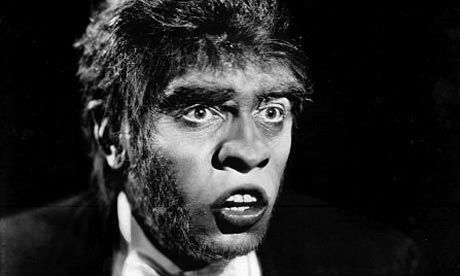
Frederic March as an ape-like Mr. Hyde in Rouben Mamoulian's Dr. Jekyll and Mr. Hyde (1931) © Paramount Pictures
Picture
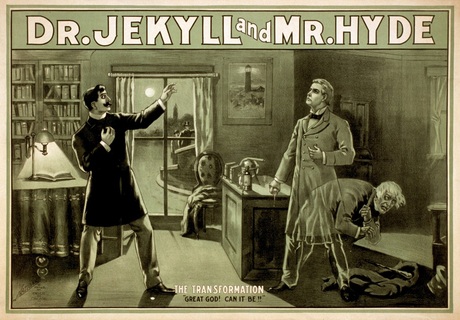
This 1880s poster for Dr. Jekyll and Mr. Hyde depicts instead the spiritual diminution of Hyde, but it also depicts the judgement of Utterson, who is literally pointing the finger at Jekyll
Picture
Picture
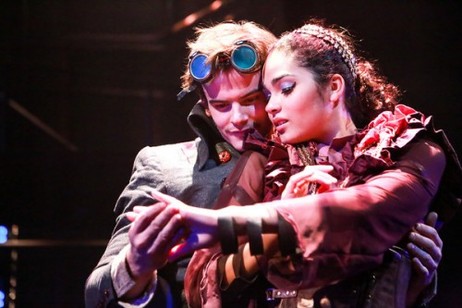
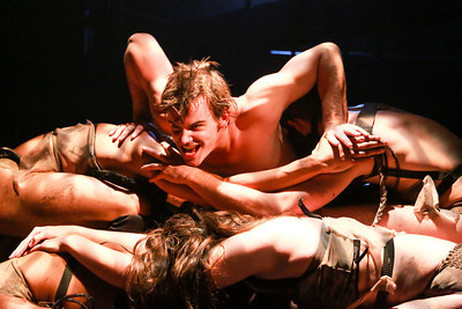
Alex Mills as Jekyll and Hyde and Brittany O’Grady as Fiancee in a theatrical adaptation of the tale by Nathan Weinberger and Paata Tsikurishvili, directed by Tsikurishvili for the Synetic Theater (2012). Photo by Johnny Shryock. Note here that Jekyll/Hyde's sexuality is put front and center.
Picture
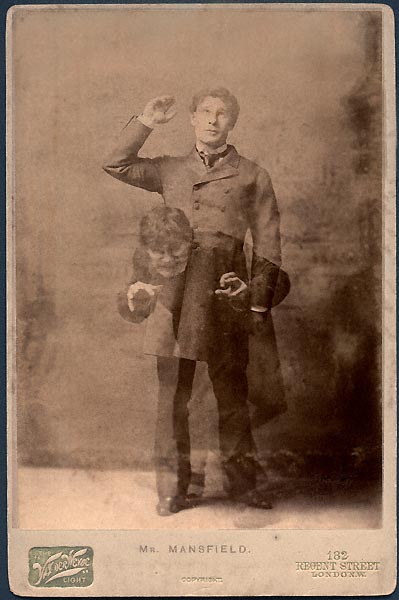
In this double exposure, Richard Mansfield suggests a double subjectivity or Dissociative Identity Disorder. Mansfield starred in the first stage adaptation of the novella (1887).
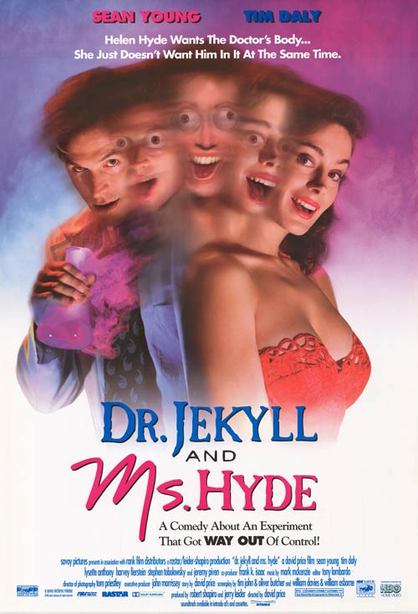
Depending on how much time you spend on the novella, you may want to ask students to watch videos of film adaptations of the story. The Jekyll and Hyde Laboratory--a blog dedicated exclusively to the many adaptations of the story--has a wonderful page that collects links to videos and full-length movies. Check it out here. There are many, many resources there that might be useful for you! It's particularly useful if you want to talk about gender. There are almost no women in Stevenson's book at all, and many adaptations of the story invent female characters, often by giving Jekyll a wronged fiancee (as in the image above) or by making Hyde into a woman.
Picture
Movie poster for Dr. Jekyll and Ms. Hyde (1995) © Savoy Pictures
Asking students to watch and respond critically to adaptations will open up all sorts of questions about gender that the book only alludes to obliquely.

Other questions to consider are names, setting, and the recurring motif of dreams throughout the book. Students generally have a lot to say about the word "utter" in the name Gabriel John Utterson and also the pun on "hide" (both the noun denoting an animal skin and the verb "to hide") in Edward Hyde's name. As for settings, it's important to think about the oppressive smog that hovers throughout London and how that contributes to the plot. Finally, ask your students to consider why Stevenson would choose to relate certain information in dreams as opposed to through the exposition of the seemingly objective Mr. Utterson. Do these discussions add to one or more of the possible allegories that have already been discussed?
Next page
Last page
1 Comment

Teaching the Declaration of Independence

6/3/2014

0 Comments


Picture
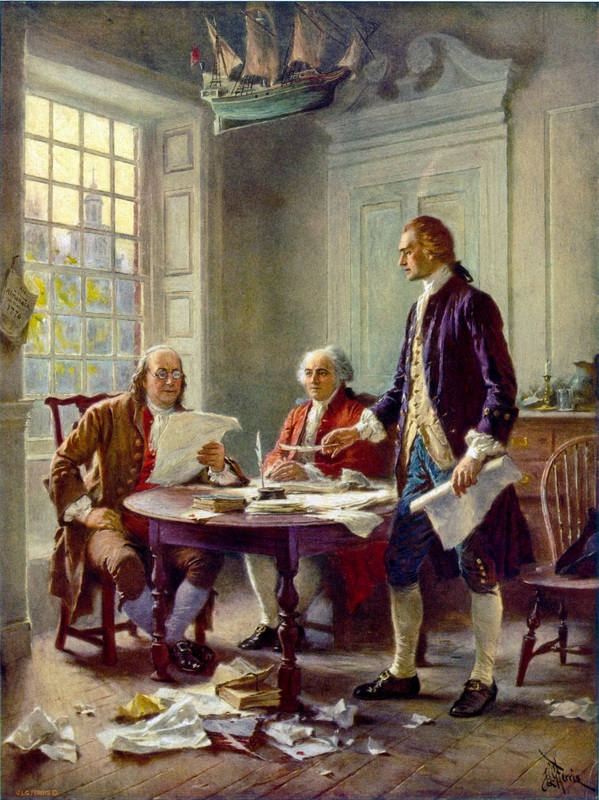
Jean Leon Gerome Ferris, Writing the Declaration of Independence, 1776
I've taught the Declaration of Independence in a variety of contexts: an introductory rhet-comp class at UC Davis and a ninth-grade American lit class at the OHS. Although the Declaration is a rhetorical masterpiece, I find that it really helps to teach it in context instead of in isolation.  Although close-reading this text is really rewarding, it helps students to have a sense of how Jefferson, Adams, and Franklin were both reacting against ideas of the time and also building on ideas in their cultural moment.

One way to put the Declaration into context is through the concepts of "natural rights" and the "state of nature" in order to get students to think about social contract theory. I like to introduce my students to Thomas Hobbes, John Locke, George Mason, and a book called The Pyrates written under a pseudonym but assumed to be by Daniel Defoe.


State of Nature:
Hobbes’ Leviathon (1651): Hobbes justifies absolute monarchy by describing the state of nature, a hypothetical time of radical freedom before government or law, as a “war of all against all.” Because every single person has the same right to life, a state of chaos and anarchy exists. In order to establish life-preserving peace, the monarch is set up to protect us from this terrible state of nature, described as follows:
In such condition there is no place for industry, because the fruit thereof is uncertain, and consequently, not culture of the earth, no navigation, nor the use of commodities that may be imported by sea, no commodious building, no instruments of moving and removing such things as require much force, no knowledge of the face of the earth, no account of time, no arts, no letters, no society, and which is worst of all, continual fear and danger of violent death, and the life of man, solitary, poor, nasty, brutish, and short.
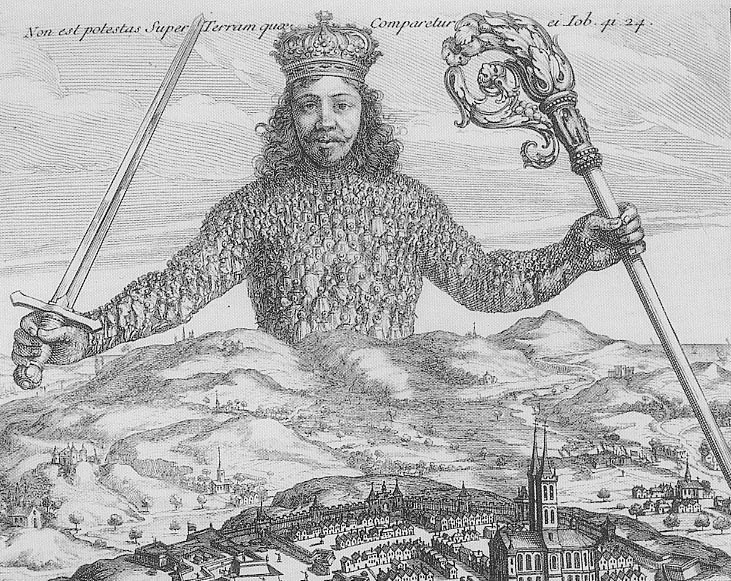
Hobbes wrote that we have to surrender some of our absolute freedom in order to secure our safety.  In doing so we create an absolute sovereign to whom we submit in the interest of self preservation. The monarch (figured in the form of the biblical sea-monster, the Leviathan) will always usurp more and more of our freedoms as his power grows larger and larger.
Picture
Thomas Hobbes. Leviathan. London: Andrew Crooke, 1651.
Two of what Hobbes calls the "principle rights of the sovereign" are as follows:
  • because a successive covenant cannot override a prior one, the subjects cannot (lawfully) change the form of government.
  • because the covenant forming the commonwealth results from subjects giving to the sovereign the right to act for them, the sovereign cannot possibly breach the covenant; and therefore the subjects can never argue to be freed from the covenant because of the actions of the sovereign. [In other words, the sovereign is the law, so he cannot break the law.]
These are just two of the ways that the sovereign will work to consolidate and protect his power. Once you surrender some of your liberty to protect your safety, it's a slippery slope until you have given up all of your liberty to the monarch. There is, according to Hobbes, no lawful recourse to escape the monarch.

Locke’s Second Treatise on Government (1689): Locke proposes a defense against Hobbes’ thesis by defining the idea of “natural law.”
To properly understand political power and trace its origins, we must consider the state that all people are in naturally. That is a state of perfect freedom of acting and disposing of their own possessions and persons as they think fit within the bounds of the law of nature. People in this state do not have to ask permission to act or depend on the will of others to arrange matters on their behalf. The natural state is also one of equality in which all power and jurisdiction is reciprocal and no one has more than another.
Locke agrees with Hobbes that an anarchical and hypothetical state of nature is a state of radical equality; however, Locke disagrees with Hobbes' premise that a social contract necessarily leads to an absolute monarch by making the argument that concomitant with the instinct to protect one's property comes an inherent awareness of reciprocity and fairness (i.e., natural "law"). This leads Locke to redefine the concepts of natural rights from what Hobbes suggested.  The ideas of natural law and natural rights are what George Mason and the writers of the Declaration of Independence use to justify what might otherwise have been deemed an act of treason.

I like to ask my students to look closely at the language of the following three passages to think about what each writer names as a "natural right" and to consider the differences between these rights. What does it mean to substitute "possessions" with "happiness"? Are those the same thing or different things? How do you know and why does it matter?

Natural Rights
John Locke: The state of nature has a law of nature to govern it, which obliges every one: and reason, which is that law, teaches all mankind, who will but consult it, that... no one ought to harm another in his life, health, liberty, or possessions.

George Mason: [A]ll men are by nature equally free and independent and have certain inherent rights, of which, when they enter into a state of society, they cannot, by any compact, deprive or divest their posterity; namely, the enjoyment of life and liberty, with the means of acquiring and possessing property, and pursuing and obtaining happiness and safety.

Jefferson et al: We hold these truths to be self-evident, that all men are created equal, that they are endowed by their Creator with certain unalienable Rights, that among these are Life, Liberty and the pursuit of Happiness.

Social Contract Theory
We can see these thinkers reacting against Hobbes in the way they take the concept of natural rights and then apply it to the social contract theory.

George Mason:
[G]overnment is, or ought to be, instituted for the common benefit, protection, and security of the people, nation, or community; of all the various modes and forms of government, that is best which is capable of producing the greatest degree of happiness and safety and is most effectually secured against the danger of maladministration. And that, when any government shall be found inadequate or contrary to these purposes, a majority of the community has an indubitable, inalienable, and indefeasible right to reform, alter, or abolish it, in such manner as shall be judged most conducive to the public weal.
Jefferson et al:
[To] secure these [natural] rights, Governments are instituted among Men, deriving their just powers from the consent of the governed, — That whenever any Form of Government becomes destructive of these ends, it is the Right of the People to alter or to abolish it, and to institute new Government, laying its foundation on such principles and organizing its powers in such form, as to them shall seem most likely to effect their Safety and Happiness… when a long train of abuses and usurpations, pursuing invariably the same Object evinces a design to reduce them under absolute Despotism, it is their right, it is their duty, to throw off such Government, and to provide new Guards for their future security.
How does each respond to Hobbes? How would you describe these two in relationship to each other? What is the difference between a right and a duty?

Remember the idea that Hobbes stated—that subjects cannot (lawfully) change the form of government?  A key word in this phrase is “lawfully.”  What are the ways that Mason and Jefferson take to prevent the “insidious” words of treason and lawlessness from being levied against them? It's useful to send students to www.ushistory.org to see a side-by-side copy of of the various drafts of the Declaration, so that they can see how carefully each word was chosen.

The Pyrates:

Picture
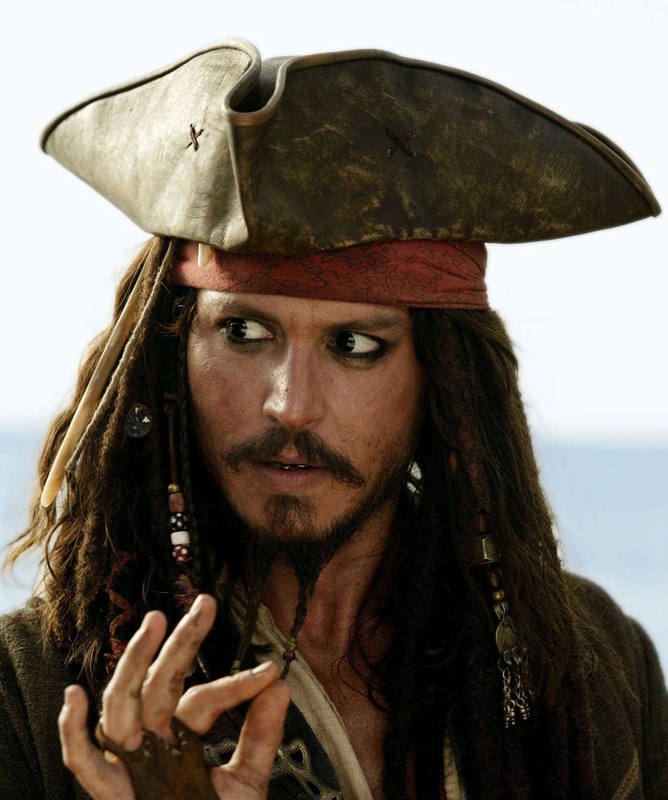
Johnny Depp as Capt. Jack Sparrow, © Buena Vista Pictures
I ask students to read a very short selection from Defoe's The Pyrates that focuses on Capt. Misson, who makes the argument that he and his men are not "pirates" but "freedom fighters." Peter Leeson argues that pirates are a model for a real, practical form of social contract theory, so linking our founding fathers to pirates is perhaps not as crazy a move as one might think. I like to ask my students at this point to compare and contrast the rhetoric that Capt. Misson uses in The Pyrates to the rhetoric that Jefferson et al use in the Declaration. How does Jefferson try to convince us that he’s not like a pirate, taking the law into his own hand?

We consider classic, Aristotelian logic:

  • Logos (logical claims built on premises – look for syllogisms)
  • Pathos (emotional claims made to provoke the reader’s feelings)
  • Ethos (claims about the speaker’s authority or reputation asking the reader to trust the speaker)
Students love to point out that, whereas Capt. Misson masks anarchy and chaos as "freedom," Jefferson focuses on contracts, laws, and duties, even though the idea of the natural right to liberty is obviously important as well.

This activity impresses students by showcasing the masterful way that Jefferson and his co-writers forestall the accusation of treason or lawlessness. The economy with which Jefferson establishes his syllogism, the emotion that he provokes in calibrated turns by increasing the violence in his list of grievances, and the ethos of authority he creates with his appeals to philosophy, "self-evident" truth, and God: all of these rhetorical appeals work together to create a document that is both compelling and poignant. 

Plus, it's a good excuse to post the picture of Johnny Depp in his role as Capt. Jack Sparrow.

Next page
Last page
0 Comments
Forward>>

    Claire Dawkins

    English Instructor at Stanford's Online High School

    Archives

    August 2015
    May 2015
    October 2014
    September 2014
    June 2014
    May 2014
    April 2014

    Categories

    All
    Assignments
    Beaumont
    Behn
    Beowulf
    Bishop
    Brathwaite
    Cartier-Bresson
    Chaucer
    Coleridge
    Creative Writing
    Dickinson
    Donne
    Early American Literature
    Exams
    Gender Theory
    Genre
    Glaspell
    Horace
    John Smith
    Lesson Plans
    Literature Of Exploration
    Melville
    Milton
    My Smart Friends
    Ovid
    Pearl Poet
    Pynchon
    Queen Elizabeth I
    Rowlandson
    Shakespeare
    Sophocles
    Spenser
    Sterne
    Texts And Contexts
    Theory
    Visual Analysis
    Walker
    Whitman
    Williams
    Woolf
    Writing Instruction

    RSS Feed

Proudly powered by Weebly